In this case study, we outline our work with Superlayer, a modern revenue platform for B2B sales teams, to design and develop the Conversation Intelligence module. The module enables Superlayer’s customers to optimize their sales processes, better understand clients, and gain valuable insights from their business conversations.
Empowering sales teams with AI
Superlayer sought to enhance their platform by incorporating a Conversation Intelligence module. They aimed to provide sales teams with a tool to record, analyze, and extract valuable information from sales calls, ultimately helping them understand their customers better and improve sales efficiency.
Leveraging recent AI advancements in natural language processing (NLP) and speech recognition, the Conversation Intelligence module aims to efficiently analyze and extract valuable information from sales calls. By employing accurate speech-to-text transcription and cutting-edge AI models and presenting the results in an intuitive user interface, the new module allows for faster ramp-up times for new members of the team as well as increased efficiency for senior reps.
Harnessing AI advancements for sales call insights
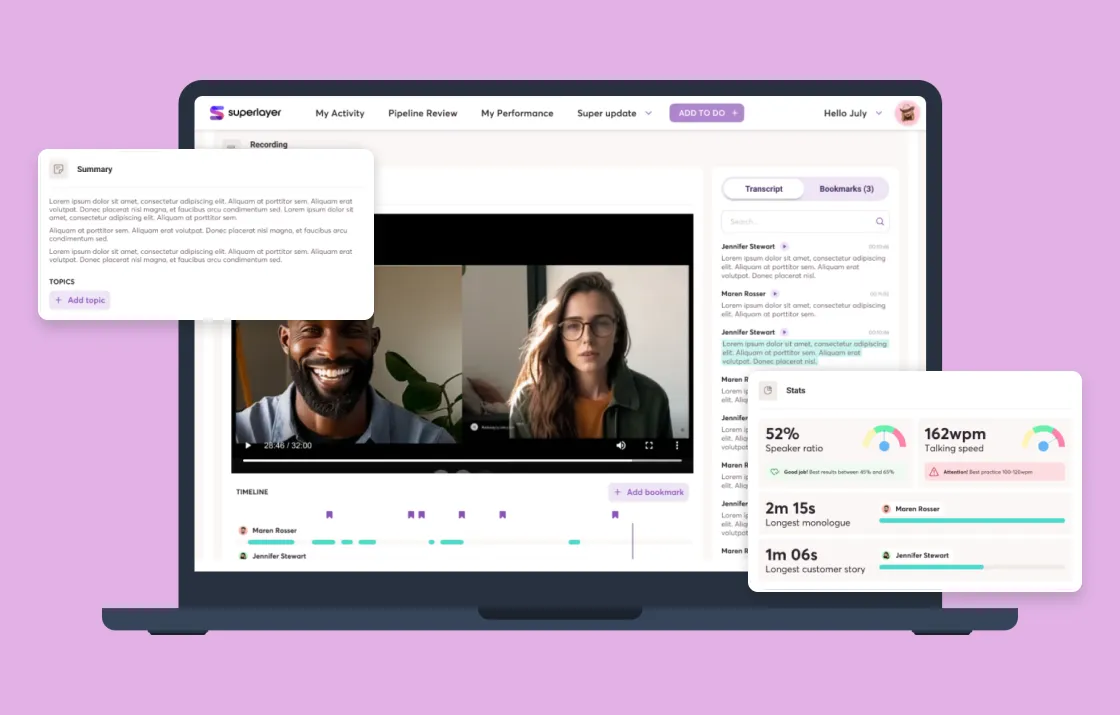
Superlayer’s team collaborated with Buildo to design and develop the conversation intelligence module, seamlessly integrating it into the existing platform. The module records sales calls, generates transcripts and summaries, and provides insights that enable users to gather valuable information and analysis from the calls. This allows Superlayer’s customers to quickly evaluate the status of a deal and optimize their sales processes without re-watching entire calls or taking notes during the meeting.
By tagging calls, sales representatives can swiftly filter and locate similar calls within their team, analyzing outcomes and strategies employed. Furthermore, sales team managers gain access to a wealth of statistics, empowering them to monitor individual performance, pinpoint areas for growth, and provide targeted mentoring to elevate their team’s success.
In order to develop an effective Conversation Intelligence module for Superlayer, our team conducted a thorough analysis of the available technical solutions. We sought to identify the best combination of technologies that would enable seamless meeting recording, accurate transcription, and insightful analytics, all while being user-friendly and reliable.
Discovering insights
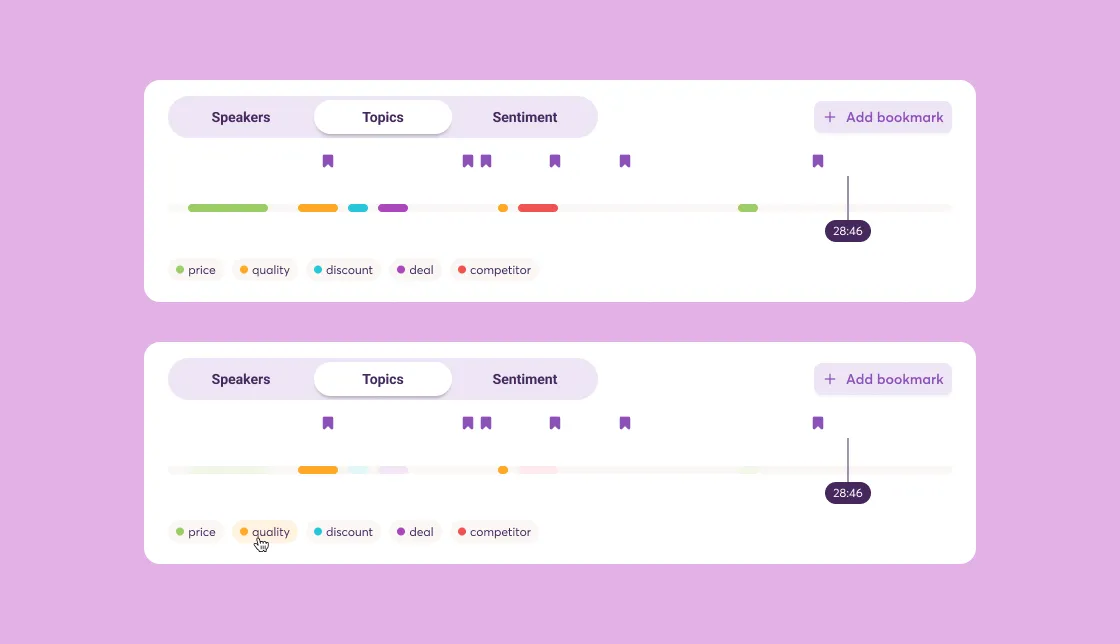
We assessed various AI models to perform speech-to-text. While many models excelled in English language processing, we found that their performance diminished for other languages. Upon obtaining the transcripts, we aimed to explore diverse approaches for generating valuable summaries, identifying crucial topics, and extracting key insights from each call.
Architecture: a story of integration and fast bootstrapping
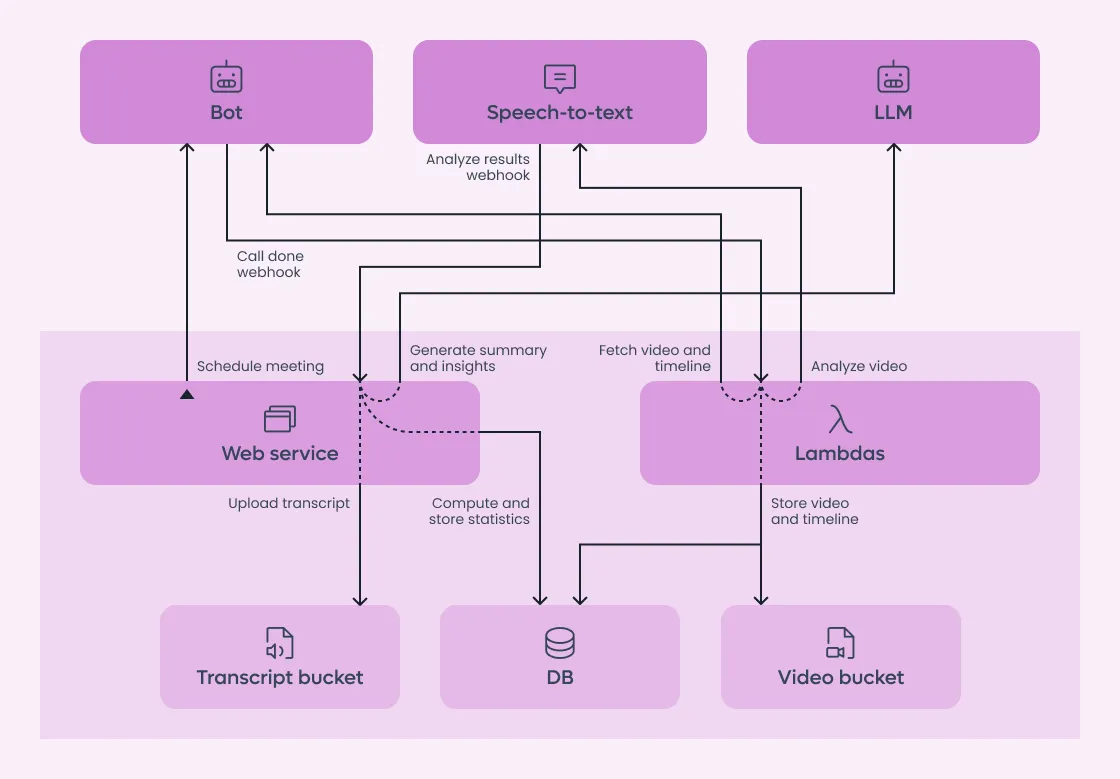
When a sales representative joins a scheduled call with a client, the entire session is recorded. In an asynchronous fashion, the call is permanently stored and a transcript is generated. Once the raw transcript is ready, a customized data transformation is performed to provide advanced features such as the timeline and the diarized text. Intermediate results of the overall process will be available as soon as the corresponding sub-task is completed, for a prompt and seamless user experience.
Call insights using LLM technology
The feature’s primary focus is to extract valuable observations that indicate whether a client has a solid inclination to purchase or try out a product or if there is any indication to the contrary.
To accomplish this, we employed specific Prompt Engineering strategies, including:
- Clearly defining the call transcript’s domain: Outlining who is involved in the professional conversation.
- Structuring the task: Formally and meticulously describe the interpretation task. This involves explaining the corresponding emotions and tone of voice that would classify insights as positive or negative, apart from their objective content.
- Preventing false information: To avoid generating incorrect insights, the output is limited, and the model is made to cross-check its results by providing exact transcript references for each retrieved insight.
- Templating prompt and output: Making sure the input prompt and the produced output are properly structured. Each component (like a transcript, insight description, title, reference, or categorization) is denoted using specific delimiters so that both the prompt and output can be programmatically processed.
Given that the LLM’s input and output do not fit within the maximum model tokens available, a token-window (segmenting) approach was adopted. Even if it does come with the drawback of making more API calls, we found out that this strategy best meets the feature requirements.
Increasing sales efficiency through Conversation Intelligence
Our collaboration with Superlayer resulted in a powerful Conversation Intelligence module that empowers sales teams to better understand their customers and optimize their sales processes. The feature assists Superlayer’s customers in reducing the time spent reviewing sales calls and helps them achieve increased efficiency with faster ramp-up times and higher win rates.